
Last Updated: November 9, 2026
Quick Summary
A triple helix ear piercing is three separate piercings placed along the upper outer rim of the ear cartilage, following the curve from front to back. Each one passes through the cartilage rim itself, so expect months of healing rather than weeks and a real commitment to aftercare.
- Spacing is where most triple helixes succeed or fail, so your anatomy decides the layout.
- Triple helix pain is sharp and quick, though cartilage stays tender for days afterward.
- Full maturity takes 9-12 months or longer, and downsizing is safe once tissue settles.
- Getting all three at once gives an immediate look but loads three healing wounds onto one ear.
- Sleeping on a fresh triple helix is the most common cause of irritation bumps and tilted angles.
Table of Contents
- What a Triple Helix Piercing Is and Where It Sits
- Placement, Spacing, and Ear Anatomy
- Triple Helix Ear Piercing Pain: What to Expect
- Triple Helix Ear Piercing Healing Time and Stages
- All Three at Once or Staged? A Decision Guide
- Triple Helix Ear Piercing Jewelry: Sizes and Materials
- Triple Helix Piercing Aftercare and Common Mistakes
- Risks, Complications, and When to See a Doctor
- Frequently Asked Questions
What a Triple Helix Piercing Is and Where It Sits
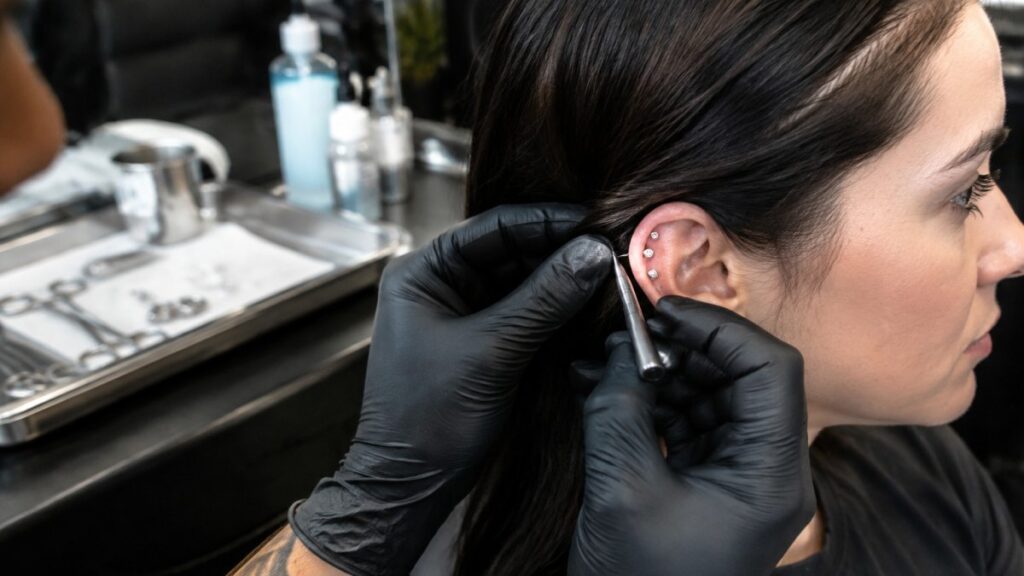
A triple helix ear piercing is three separate piercings placed along the upper outer rim of the ear cartilage, following the curve from front to back. Each one passes through the cartilage rim itself, not the lobe, which is why placement and spacing matter so much.
A triple helix is a layout decision first and a piercing second. Get the spacing right and the ear looks balanced; rush it and you get three holes fighting for room.
- Three piercings through the upper cartilage rim
- A curved or straight line, depending on your ear shape
- Cartilage healing, which takes far longer than a lobe
- A real commitment to aftercare for months, not weeks
The placement sits above the standard helix position and wraps toward the top of the ear. Some people call it a triple cartilage piercing. Same thing, three holes, one clean line.
Triple Helix vs. Triple Forward Helix
These two get confused constantly. A triple helix runs along the upper outer rim. A triple forward helix sits on the inner fold near the face, just above the tragus.
Different cartilage, different healing behavior, different jewelry angles. The row that curves around the top of your ear is the helix; the small cluster near your cheek is the forward helix.
Before you book anywhere, know the professional piercing safety standards a studio should follow. Ask about sterilization, needle use, and jewelry quality, a shop that hesitates is telling you something.
Placement, Spacing, and Ear Anatomy
Spacing is where most triple helixes succeed or fail. The three piercings need enough cartilage between them to heal without crowding, and enough visual rhythm to look intentional.
Your anatomy decides the layout. Cartilage thickness varies, and the curve of your rim sets how much room you have.
Why the Cartilage Rim Decides Your Layout
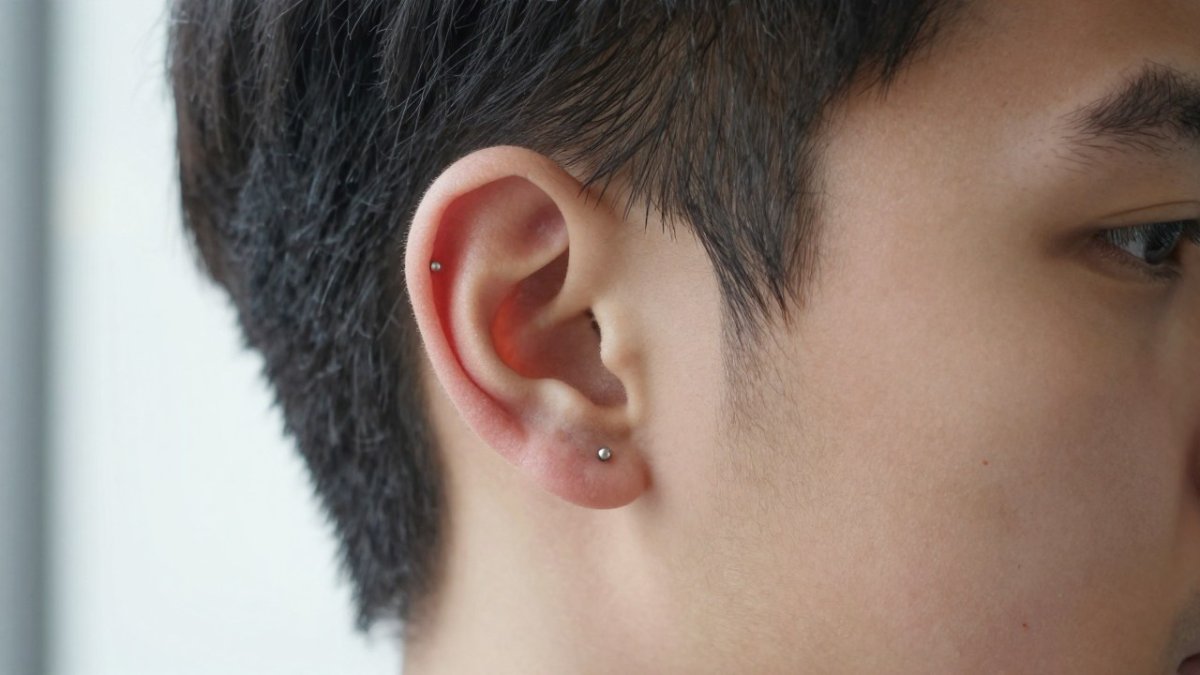
The rim is not a flat surface. It curves, thickens, and thins as it travels up and around. That shape limits where each piercing can sit.
- Rim thickness at each of the three points
- The curve so the line follows your ear, not a template
- Angle so each stud sits perpendicular to the tissue
- Room to swell without the jewelry pressing on a neighbor
A common mistake is copying spacing from someone else’s photo. What looks even on one ear can look cramped or lopsided on another.
Triple Helix Ear Piercing Pain: What to Expect
Triple helix ear piercing pain is sharp and quick, and most people rate it as moderate.
The bigger story is after. Cartilage stays tender for days and flares whenever you bump it, sleeping on that side is the usual culprit.
- During: a sharp sting, a few seconds per piercing
- Right after: warmth, throbbing, mild swelling
- First week: tenderness when you touch or clean it
- Flare-ups: random aches for weeks if you roll onto it at night
Pain tolerance varies. Compared with a lobe, cartilage feels noticeably sharper; compared with a tattoo, it’s quicker but the soreness lingers longer.
Three piercings in one sitting means three waves of that sting. Staging them spreads the discomfort out.
Triple Helix Ear Piercing Healing Time and Stages
Triple helix ear piercing healing time runs long. Cartilage has limited blood flow, so it repairs slowly compared with soft tissue. Expect months, not weeks.
A realistic timeline looks like this:
| Stage | Timeframe | What You’ll Notice |
|---|---|---|
| Initial healing | First 2-4 weeks | Swelling, tenderness, some crusting |
| Early stabilization | 1-3 months | Swelling drops, tenderness eases |
| Ongoing healing | 3-9 months | Piercings look calm but are still fragile |
| Full maturity | 9-12 months or longer | Tissue settles, downsizing is safe |
Those are general ranges, not promises. Some ears heal faster, some slower, cartilage is stubborn that way.
The mistake we see most: people assume a calm-looking piercing is a healed piercing. It isn’t. A triple helix can look fine and still react badly to a bumped phone, a tight helmet, or a new pillow.
All Three at Once or Staged? A Decision Guide
Getting all three at once gives you the look immediately but loads three healing wounds onto one ear. Staging is slower but far gentler on the tissue and your daily life.
Here’s the trade-off laid out plainly:
| Factor | All Three at Once | Staged (Two Then One, or One at a Time) |
|---|---|---|
| Finished look | Immediate | Weeks to months out |
| Healing load | Three wounds on one ear at once | Spread across separate healing windows |
| Soreness | Three waves of sting in one sitting | One or two waves per visit |
| Sleep disruption | Highest, one side off-limits for months | Lower, and you can rotate which ear is healing |
| Risk of angle drift | Higher if swelling crowds the posts | Lower, because each piercing settles before the next |
| Cost timing | One outlay | Spread over multiple visits |
| Total calendar time | One long healing window | Longer overall, but each window is easier |
People who heal cartilage well and can sleep off that ear do fine with all three at once.
If you stage, two then one is most popular, you get most of the look early and carry only one fresh wound through round two. One at a time is gentlest but slowest. Some piercers space visits by roughly the time it takes swelling to drop and the first downsizing to happen.
Before you book, ask the piercer these questions. The answers tell you whether they’re thinking about your ear or just filling a slot:
- How much rim do I have at each of the three points, and does that change the plan?
- If we stage, how long between visits, and do you downsize before adding the next?
- What’s the plan if one piercing swells more than the others?
- Can you show me the jewelry length you’d start with and the length I’d downsize to?
- What do you want me to do if a bump forms during healing?
Think about daily life first.
If you’re weighing where to get pierced, it’s worth understanding the risks of getting piercings at the mall versus a professional studio.
Triple Helix Ear Piercing Jewelry: Sizes and Materials
Jewelry choice makes or breaks a triple helix. The wrong material irritates healing cartilage. The wrong size crowds the piercings or catches on everything.
For fresh piercings, we recommend:
Jewelry choice matters. Implant-grade titanium, flat-back labret studs, and small studs are common choices for healing cartilage, and solid gold is often worn once healed. Skip anything plated, nickel-heavy, or mystery metal. Cheap jewelry is the fastest route to a piercing bump.
If you’re shopping for styles that suit a fresh piercing, the best earring styles for newly pierced ears covers options built for healing ears rather than fully healed ones.
Downsizing matters too. Once swelling drops, long posts start catching. A shorter post keeps the angle stable and stops the jewelry from tilting.
Triple Helix Piercing Aftercare and Common Mistakes
Triple helix aftercare is simple and people overcomplicate it. Clean gently, keep it dry, leave it alone.
- Wash your hands with soap and water before touching the area, every time (the CDC).
- Spray sterile saline solution on the front and back of each piercing. Let it sit for a few seconds rather than scrubbing.
- Pat dry with clean gauze. Don’t rub, and don’t use a cloth towel that other people use.
- Skip harsh soaps, alcohol, hydrogen peroxide, and ointments. They dry the tissue and slow healing.
- Keep hair, makeup, and lotion away from the piercings. Pull long hair back on that side, especially at night.
- Sleep on the opposite side or use a travel pillow with your ear in the hole. This one step prevents more problems than any product.
Now the mistakes. These are the ones that set healing back, and each one has a mechanism behind it:
- Twisting or rotating the jewelry to “check” it. This drags crust and bacteria through the fresh channel and tears the fragile tissue inside. Leave it still.
- Over-cleaning until the skin dries and cracks. Cracks invite irritation and infection. Twice a day is enough; more is not better.
- Swapping jewelry too early. The channel isn’t strong enough to hold a new piece, and the change re-injures it. Wait until the piercer downsizes and clears you for a change.
- Sleeping on the pierced ear night after night. Pressure tilts the angle and traps moisture, which is the usual recipe for an irritation bump.
- Using cotton balls that leave fibers behind. Fibers work into the piercing and act as irritants. Gauze or a clean spray is safer.
- Touching it with unwashed hands out of habit. Most infections start with hands, not with the studio.
Downsizing is part of aftercare, not a separate errand.
If you have sensitive skin, the best earring backings for sensitive skin is worth a read before you change jewelry for the first time.
Watch out: sleeping on a fresh triple helix is the single most common cause of irritation bumps and tilted angles.
Risks, Complications, and When to See a Doctor
Most triple helixes heal without drama. Some don’t.
Normal: mild redness, light crusting, occasional tenderness, small bumps that come and go.
Piercing bumps are the most common complaint. They usually come from pressure, friction, or moisture, not infection.
Rejection is rarer in helix piercings but possible. If you’re worried, learn how to tell if a piercing is rejecting so you catch it early.
If you’re unsure whether something is irritation or infection, get it looked at.
A triple helix rewards patience.
At Sideshow Tattoo and Piercing, our hand-picked artists focus on the placement and care of every piercing.
Contact Sideshow Tattoo and Piercing to plan your triple helix around your anatomy and your schedule.
Frequently Asked Questions
Can you get a triple helix pierced at once?
Yes, many piercers will place all three in one sitting, but it is not automatically the right call. Three fresh wounds on the same cartilage rim means three times the swelling and a longer combined healing window, and you cannot sleep on that ear for months. Ask your piercer to check your anatomy first. If the cartilage rim is thin or the curve is tight, staging the piercings a few months apart often gives a cleaner, more even result.
How long does a triple helix piercing take to heal?
Cartilage heals slowly. Expect the surface to look calm within a few months, but full healing for a triple helix ear piercing commonly runs six to twelve months, and sometimes longer when three piercings share one ear. Healing time depends on spacing, jewelry fit, and how well you avoid pressure and sleeping on that side. Keep the initial jewelry in until your piercer confirms the tissue is stable, and downsize when they tell you to.
What jewelry is best for a triple helix piercing?
For a fresh triple helix ear piercing, jewelry choice matters as much as placement. Flat-back labret studs in implant-grade titanium are a common starting point because they sit flush, catch less on hair, and reduce pressure on the cartilage. Keep the initial size simple and let your piercer handle downsizing once swelling drops. Hoops and gold jewelry can look great, but save them for fully healed piercings so the seam does not irritate the channel.
How do you clean a triple helix piercing?
Spray sterile saline solution on the front and back of each piercing once or twice a day, then leave it alone. Do not twist, rotate, or pick at crust, and skip alcohol, hydrogen peroxide, and antibiotic ointment unless a doctor prescribes them. Keep hairspray, perfume, and makeup away from the area, and dry gently with clean gauze. If a piercing bump appears, reduce pressure and contact your piercer rather than adding more products.