

Last Updated: November 4, 2026
Quick Summary
Start by checking the stamp on the back of the earring, clasp, or post, since a karat mark like 10K, 14K, 18K, or 24K shows the gold content the maker claims. A stamp is only a claim, so confirm with a magnet test, a visual check for wear and plating, and a professional acid test for a firm answer on real gold.
- Look for a karat stamp such as 10K, 14K, 18K, or 24K on the back, clasp, or post.
- Real gold is not magnetic, so an earring that sticks to a magnet is likely not solid gold.
- Wear at posts and backs that shows silver or dark metal means plating has worn through.
- The water test is only a rough check because alloys and stones change how an earring sinks.
- A jeweler’s acid test or X-ray measurement gives a firm, written answer on karat.
Table of Contents
- Start With the Stamp: Reading Gold Jewelry Hallmark Meanings
- Testing Gold With a Magnet and What the Result Tells You
- How to Identify Gold at Home With Water and Its Limits
- Visual Checks: Discoloration, Wear, Plating and Engraving
- Safety First: Protecting Your Jewelry and Your Skin During Tests
- Booking Your Jeweler’s Acid Test or Appraisal Next
- Frequently Asked Questions
Start With the Stamp: Reading Gold Jewelry Hallmark Meanings
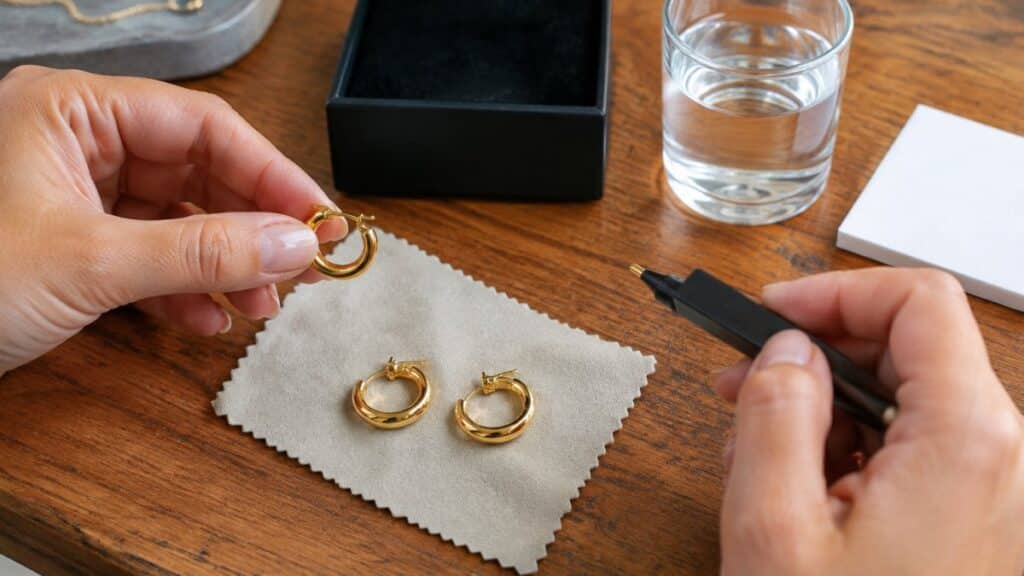
Look for a small stamp on the back of the earring, the clasp, or the post. That mark is a hallmark, and it tells you the gold content the maker claims. The stamp is a good place to start because it is the fastest first check.
Gold is measured in karats, and a stamp tells you how much real gold is in the piece (Buying Platinum, Gold, and Silver Jewelry). Pure gold is 24K, and lower karat numbers mean more of the metal is mixed with other alloys (Buying Platinum, Gold, and Silver Jewelry).
What 10K, 14K, 18K and 24K Mean
- 24K: Nearly pure gold. It is soft and scratches easily, so it is rare in earrings.
- 18K: 75 percent gold. It has a rich color and is a good choice for fine jewelry.
- 14K: 58.3 percent gold. It balances color and durability well.
- 10K: 41.7 percent gold. It is a durable option and is among the lowest karats sold as gold.
Why a Stamp Alone Does Not Prove Gold
A stamp is a claim, not a guarantee. Stamps can be copied, faked, or added to plated pieces. Gold-plated and gold-filled jewelry can also carry marks that look like karat numbers. Gold-filled pieces have a thick layer of gold bonded to a base metal, while plated pieces have a much thinner coating that wears off over time.
So use the stamp as a starting point, then run the other checks below before you decide.
Testing Gold With a Magnet and What the Result Tells You
A magnet is a simple test you can do at home.
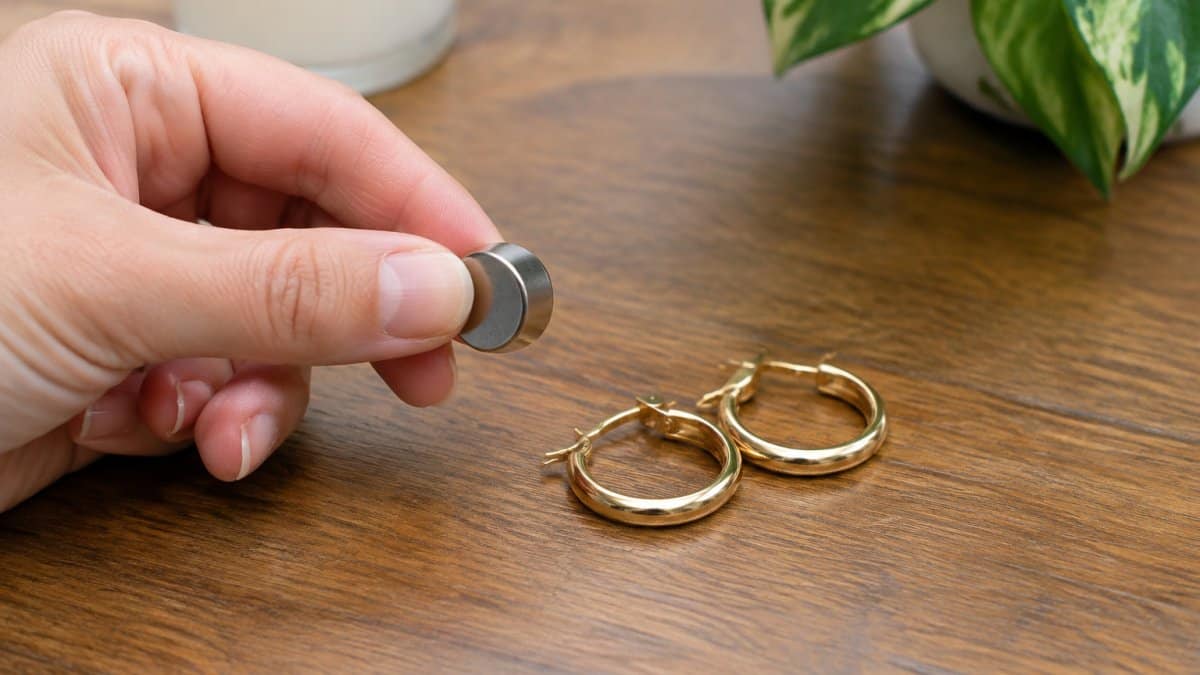
If the earring sticks to the magnet, it likely contains iron or steel as its base metal, which means it is not solid gold.
Think of the magnet as a way to rule things out. A pull means “probably not gold.” No pull means “keep checking.”
Each quick home check gives a different kind of signal, so here is what each result tells you.
| Check | If the result is… | What it means |
|---|---|---|
| Magnet pulls | Earring sticks | Likely iron or steel base; not solid gold |
| Magnet does not pull | Earring stays put | Good sign, but not proof of purity |
| Water displacement | Solid gold cuts in cleanly | Dense, even weight; keep checking |
| Water displacement | Tumbles or drifts | Hollow, plated, or uneven weight |
| Wear at posts and backs | Dark or silver showing | Base metal showing through plating |
| Stamp check | Crisp, sits below surface | Genuine hallmark more likely |
How to Identify Gold at Home With Water and Its Limits
Here is the mechanism. Gold is dense: pure 24K gold has a specific gravity of about 19.3, meaning it is roughly 19 times heavier than an equal volume of water (Reference Tables | NIST).
A more useful version of the water test is the displacement check, not the sink-or-float check:
- Fill a small clear glass with water and set it on a level surface.
- Drop the earring in gently and watch how it enters the water, not just where it lands.
- Solid gold tends to cut straight down with little wobble. Hollow, plated, or composite pieces often tumble, drift, or land at an angle because the weight is not evenly distributed.
- Compare two earrings of the same size. A real gold pair should feel noticeably heavier in the hand than a plated pair of identical dimensions.
Watch out: a small earring with a stone, a hollow post, or a screw-back can sink, float, or drift for reasons that have nothing to do with gold content, so a single result tells you very little.
Where the test breaks down:
- Alloys change density. 10K gold is roughly 41.7 percent gold by weight, with the rest made up of silver, copper, and zinc. That pulls its density well below 24K, so a 10K earring can behave more like a silver piece than a pure gold one.
- Dense impostors pass. Tungsten, some stainless steels, and certain white alloys are dense enough to sink convincingly. Sinking is not proof of gold.
- Stones and backings skew the result. A heavy cubic zirconia or a steel butterfly back can drag a plated earring to the bottom.
- Surface tension matters. A flat, lightweight piece can rest on the water’s surface for a moment before it breaks through, which looks like floating but is not.
The water test is best used as a rough sanity check alongside the stamp and the magnet, not as a verdict.
Visual Checks: Discoloration, Wear, Plating and Engraving
Visual inspection is the least destructive test you can run, and it is where most people actually find their answer, if they know what to look for. For a fuller picture of what quality jewelry is made of, see what makes high quality piercing jewelry. The trick is separating three things that look similar at a glance: real gold, gold-filled, and gold-plated.
Gold-Plated vs. Gold-Filled: The Distinction Most Guides Skip
These two terms get used interchangeably in listings, but they describe very different products.
- Gold-plated jewelry has a microscopic layer of gold electroplated over a base metal, usually brass, copper, or steel. The gold layer is typically measured in microns and can wear through in months with daily wear.
- Gold-filled jewelry has a much thicker layer of gold mechanically bonded to a base metal core, and it must contain a meaningful layer of gold by weight to carry the gold-filled label. That layer is measured in mils, not microns, and it holds up far longer.
A gold-filled piece can carry a stamp like “1/20 14K GF,” which means the gold layer is 14K and makes up one-twentieth of the item’s total weight. A plated piece often carries no karat stamp at all, or carries a vague mark like “14K plated” or “gold tone.” Since nickel is a common base metal under cheap gold-tone plating, you can also rule it out with how to tell if jewelry is nickel free.
Reading Wear Patterns
Wear tells you what is underneath the surface. Look at the points that rub against skin, clothing, and each other:
- Posts and backs wear first on plated earrings, because they take the most friction. A post that has turned silver, copper-colored, or dark gray is showing its base metal.
- Edges and prongs on plated pieces often reveal a thin bright line of base metal where the coating has thinned.
- Clasps and hinges on gold-filled pieces usually stay gold-colored because the gold layer is thick enough to survive years of opening and closing.
- Green or black skin marks point to copper or brass reacting with your skin’s oils and acids. Solid gold does not do this.
Watch out: a single dark spot can also be tarnish, soap residue, or a reaction to lotion, so clean the piece gently with a soft cloth and look again before you conclude the plating has worn through.
What a Real Hallmark Looks Like
A genuine hallmark is struck or laser-engraved into the metal, not printed on top of it. Under a jeweler’s loupe or a phone macro lens, a real stamp has crisp edges and sits slightly below the surface.
Common legitimate stamps to recognize:
- Karat marks: 10K, 14K, 18K, 22K, 24K, or the European equivalents 417, 585, 750, 916, 999.
- Maker’s marks: a small symbol or initials registered to the manufacturer.
- Country or assay marks: on imported pieces, these indicate where the piece was tested and stamped.
A stamp with no maker’s mark, uneven spacing, or a karat number that does not match the piece’s color and weight is a reason to keep testing, not a reason to relax.
Color and Surface Cues
Solid gold has a consistent color through its full thickness, so scratches and wear do not change its hue. Because a clean gold edge can still conceal a base metal core, compare these wear patterns with other clues when identifying solid gold.
Visual checks will not give you a karat number, but they will tell you whether the piece is worth paying for a professional test, and whether it is solid, filled, or plated before you spend anything on an appraisal.
Safety First: Protecting Your Jewelry and Your Skin During Tests
Do not scratch your earrings on tile, glass, or any hard surface to test them. Scratch tests can ruin valuable pieces, and they can damage plating you may want to keep.
Be careful with household chemicals too. Vinegar and other acids can harm plated jewelry and irritate your skin, so avoid soaking earrings in them. If you have a nickel allergy, avoid handling tests that involve heat or prolonged skin contact with unknown metals, and wash your hands after handling jewelry.
For people with sensitive ears, wearing 14K or 18K gold is often easier on the skin than plated pieces, but a jeweler or doctor can give you the best advice for your own body. If a nickel allergy is part of the picture, read can you wear gold earrings with a nickel allergy for guidance on safer gold options.
Booking Your Jeweler’s Acid Test or Appraisal Next
Home checks can narrow things down, but a professional gives a firm answer on whether a piece is real gold.
When you book, ask:
- Do you test gold, and what method do you use?
- Is there a fee for the test or appraisal?
- Can I see the result in writing?
A certified appraiser or a jeweler who works with precious metals can give you a written verdict. That is especially useful if the earrings have sentimental or resale value.
If you want a quick, careful check on jewelry from our shop, reach out to the Sideshow Tattoo and Piercing team to ask about our high-quality piercing jewelry and what we use. For current details, contact us directly.
Frequently Asked Questions
How can I tell if my gold earrings are real or fake?
Start by checking for a hallmark such as 10K, 14K, 18K or 24K, usually on the post, clasp or inside the hoop. Then run a magnet test: genuine solid gold is not magnetic, so a strong pull suggests a base metal or a plated piece. A stamp alone is not proof, because some pieces carry a stamp that does not match the metal underneath. If the results are unclear or the earrings have sentimental or high value, have a jeweler perform an acid test or appraisal before you rely on them.
Can gold jewelry be fake even if it has a 14k stamp?
Yes. A 14K stamp says the piece is supposed to be 58.3 percent gold, but it can be added to plated or base-metal items, sometimes illegally. Check whether the stamp looks crisp and evenly struck, whether the piece is magnetic, and whether the color rubs off or shows a different metal underneath worn areas. A jeweler can confirm the metal content with an acid test or X-ray fluorescence testing.
Do professional jewelers charge to test gold jewelry?
Policies vary by shop, so ask the jeweler about their current policy before you visit.
What are the most reliable ways to test gold at home?
No single home test is fully reliable. A stamp check, a magnet test and a visual inspection together give a useful first screen, and the water test can add a rough density clue. Home tests can rule out some fakes, but they cannot confirm karat content with certainty. For a dependable answer, especially before buying or selling, use a professional acid test or appraisal.
Quick Summary
- Start with the stamp, but treat it as a claim, not proof.
- Use a magnet and water test to rule things out.
- Check color, wear, and engraving carefully without damaging the piece.
- Protect your jewelry and skin during any test.
- Book a professional acid test or appraisal for a firm answer.