Table of Contents
- Why Jewelry Quality Decides How Your Piercing Heals
- Implant Grade Titanium Jewelry: The Body-Safe Standard
- Metals Compared: Titanium, Niobium, and Solid Gold
- Internally Threaded vs Threadless Jewelry: Which to Choose
- How to Identify High Quality Body Jewelry Before You Buy
- Surface Finish, Sizing, and Sustainability: Details That Matter
- Conclusion
- Frequently Asked Questions
Last Updated: September 23, 2026
Why Jewelry Quality Decides How Your Piercing Heals
What makes high quality piercing jewelry comes down to one thing: the metal touches an open wound for weeks. Your piercing is a healing injury, and whatever sits in it either supports that healing or fights it.
Here’s the part most shoppers miss. A piercing can look perfect in the case and still cause months of trouble. The difference is metallurgy, threading, and finish, three things you can’t see at a glance.
Below, we break down exactly what separates safe jewelry from the rest, so you can walk into any shop and know what you’re buying.
Implant Grade Titanium Jewelry: The Body-Safe Standard
Implant grade titanium jewelry is the benchmark for new piercings because it is biocompatible, effectively nickel-free in its compliant forms, and strong enough to hold its shape for years. “Implant grade” is not a marketing phrase, it means the metal meets a published standard used for surgical implants placed inside the human body.
That is a far higher bar than “surgical steel,” a term with no legal definition in the United States. Any manufacturer can stamp “surgical steel” on a label without proving what is actually in the alloy. That is why the phrase shows up on inexpensive mall jewelry and on genuine implant-grade stock alike, and why it tells you almost nothing on its own.
What ASTM F136 Actually Specifies
ASTM F136 is the standard specification for wrought titanium-6aluminum-4vanadium ELI (Extra Low Interstitial) alloy for surgical implant applications (F136 Standard Specification for Wrought Titanium-6Aluminum-4Vanadium ELI (Extra Low…). In plain terms, it defines:
- The exact alloy recipe: roughly 6% aluminum, 4% vanadium, with the balance titanium
- Maximum allowable levels of interstitial elements like oxygen, nitrogen, carbon, and iron, which affect strength and brittleness
- Mechanical requirements including tensile strength and elongation
- Testing and certification methods a mill must follow
The “ELI” designation matters. Extra Low Interstitial titanium has tighter limits on oxygen and iron, which improves ductility, the metal bends rather than cracks. That property is why F136 titanium can be shaped into curved barbells and captive bead rings without fracturing.
ASTM F138 applies to wrought 18chromium-14nickel-2.5molybdenum stainless steel for surgical implants. It is a legitimate implant standard, but the alloy contains nickel by design.
Why Titanium Earns Its Reputation
Three properties separate compliant titanium from generic metal:
- Corrosion resistance. Titanium forms a stable oxide layer on its surface that resists body fluids and cleaning agents. That layer regenerates if scratched, which is part of why the metal stays inert inside a healing piercing.
- Low nickel content. Commercially pure titanium and F136 alloy are considered nickel-free for practical purposes. This is the single biggest reason piercers default to titanium for clients with unknown sensitivities.
- Strength-to-weight ratio. Titanium is roughly 45% lighter than steel of comparable strength. For cartilage piercings that stay tender for months, that reduced weight means less pull on the tissue.
“Implant grade” is a claim, not a guarantee. The guarantee is the ASTM standard number plus a mill certificate that ties your specific piece to that standard.
Metals Compared: Titanium, Niobium, and Solid Gold
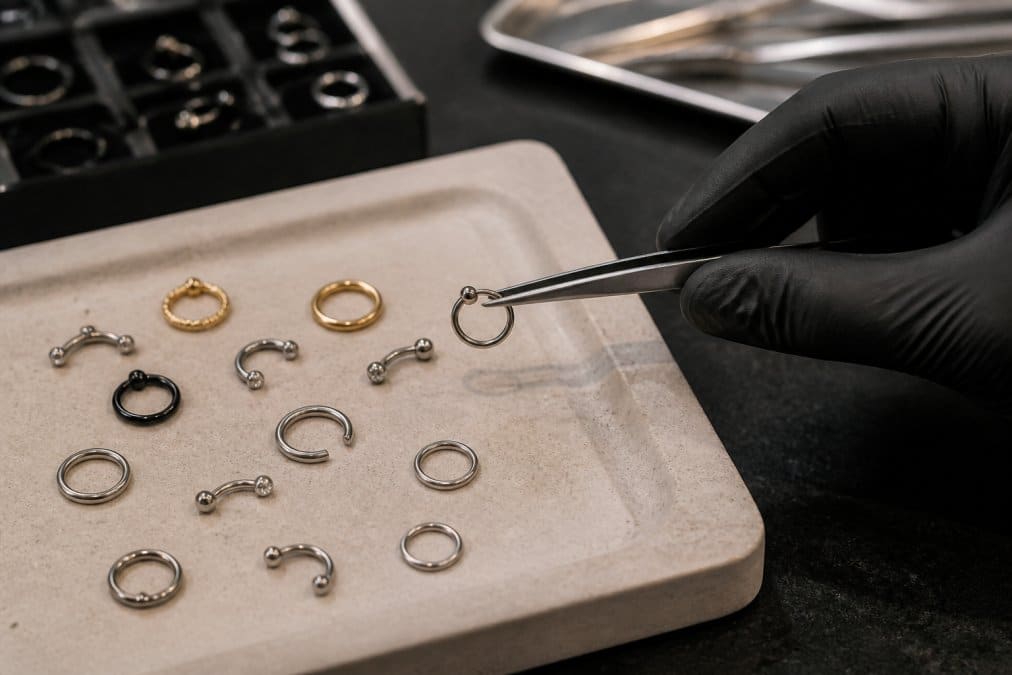
Titanium, niobium, and solid gold are metals often trusted for initial piercings. Each has trade-offs in cost, color options, and how your skin reacts.
| Metal | Best For | Key Strength | Watch Out For |
|---|---|---|---|
| Implant-grade titanium | New piercings | Nickel-free, lightweight | Limited colors |
| Niobium | Sensitive skin | Hypoallergenic, can be anodized | Softer, fewer styles |
| 14k solid gold | Healed piercings | Classic look, durable | Must be nickel-free alloy |
14k vs 18k Solid Gold and Nickel Sensitivity
14k solid gold contains more alloy metals than 18k, which is softer and purer. For most people, 14k holds up better in a healing piercing because it resists scratches.
Internally Threaded vs Threadless Jewelry: Which to Choose
Internally threaded jewelry has the threads inside the post, so the smooth shaft passes through your piercing. Threadless jewelry uses a pin that bends and presses into a hollow post. Both beat externally threaded pieces, where the threads scrape the inside of the piercing channel on the way in.
Here’s the difference in plain terms:
- Internal threading: threads hidden inside, smooth surface rides against your skin
- Threadless (press-fit): no threads at all, held by tension, easy to swap
- External threading: threads exposed, can scratch and irritate the channel
How to Identify High Quality Body Jewelry Before You Buy
Learning how to identify high quality body jewelry comes down to three checks: the metal grade, the threading style, and the finish. You can verify all three before anything touches your skin.
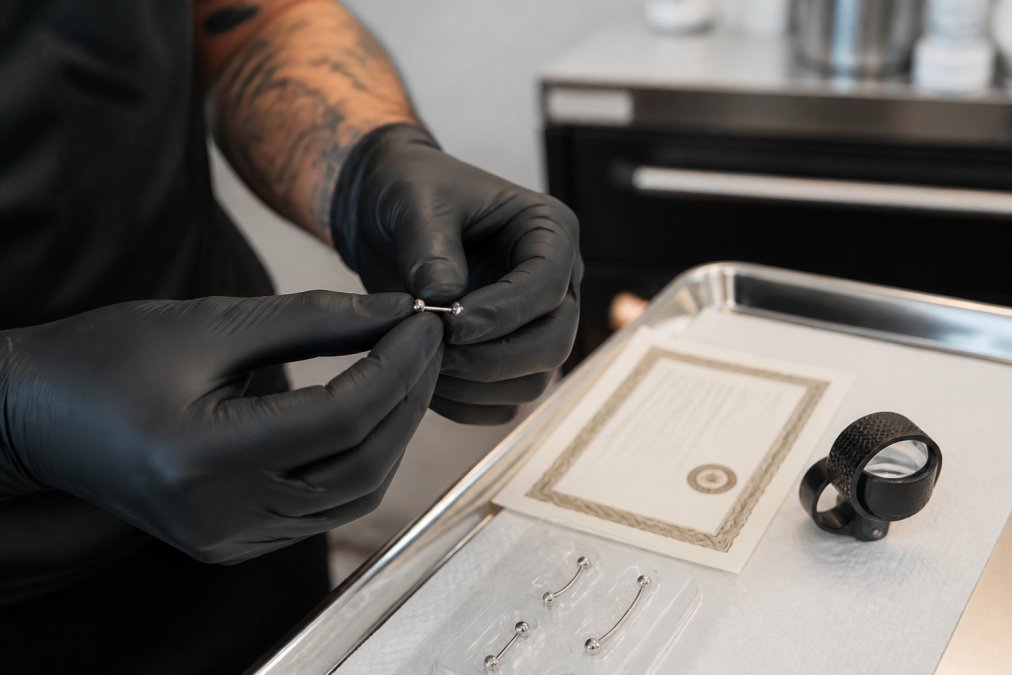
Run through this checklist at the counter:
- Ask for the metal grade and the specific ASTM standard it meets (F136 for titanium, F138 for stainless)
- Confirm the threading type (internal or threadless, not external)
- Look for a smooth, mirror finish with no pits, scratches, or tool marks
- Ask for a mill certificate or compliance card tied to the batch
- Confirm the jewelry is sterile and in sealed, dated packaging
- Check that the gauge and length fit your specific anatomy
- Ask who the manufacturer is, not just the shop name
How to Verify a Mill Certificate (and Spot a Fake)
A legitimate mill certificate, sometimes called a material test report or MTR, should include:
- The mill’s name and location. A certificate with no identifiable producer is not verifiable.
- A heat or lot number. This ties the certificate to a specific batch of melted metal. Without it, the document proves nothing about your piece.
- The ASTM standard number and revision year. “Meets ASTM F136” is weaker than “ASTM F136-13.” The revision year tells you which version of the standard was applied.
- Chemical composition results. Actual measured percentages of titanium, aluminum, vanadium, and interstitial elements, not just a pass/fail stamp.
- Mechanical test results. Tensile strength and elongation values, with the test method referenced.
Red flags that suggest a counterfeit or recycled certificate:
- The certificate lists a standard but no heat number or lot code
- The alloy composition does not match the standard it claims (for example, an F136 certificate showing no vanadium)
- The same certificate number appears across unrelated products or brands
- The seller cannot name the mill or the manufacturer when asked directly
- The document is a generic template with the shop’s logo pasted on top
Cross-Check With Published Standards
The Association of Professional Piercers jewelry standards publishes guidance on what compliant jewelry should include, including material standards and finish requirements.
A certificate on its own is not proof. The certificate must match the specific piece you are buying, same alloy, same batch, same standard revision. A valid certificate for a different product proves nothing about the jewelry in your hand.
Anatomy-Specific Sizing: The Check Most Buyers Skip
Material quality is only half the equation. Jewelry that is implant-grade but the wrong size will still cause problems.
- Lobe piercings typically start with a longer post to accommodate initial swelling, then downsize after healing.
- Nostril piercings need a shorter post than most beginners expect; too long, and the jewelry catches on clothing and shifts.
- Cartilage piercings like helix and conch require precise length because the tissue is thin and unforgiving of excess movement.
- Septum piercings depend on anatomy, the sweet spot varies widely, and a standard size may not fit.
Surface Finish, Sizing, and Sustainability: Details That Matter
Surface finish is the detail almost nobody talks about. Even implant-grade titanium can harbor bacteria if it’s covered in micro-scratches. A true mirror finish leaves fewer places for debris to hide, which supports a calmer healing process.
Never use household glue or craft adhesives to fix a loose jewelry end. Adhesives aren’t body-safe, and they can trap bacteria against the piercing. See a piercer instead.
Conclusion
Choosing jewelry is really a safety decision, and the wrong metal can undo weeks of careful healing. Sideshow Tattoo and Piercing utilizes only high-quality jewelry for all piercing services, with hand-picked professional artists matched to client needs. We focus on a safe, welcoming process from first consult to final check. CONTACT Sideshow Tattoo and Piercing for a memorable and comfortable experience.
Frequently Asked Questions
What is the 2/3 rule for piercings?
The 2/3 rule is a sizing guideline some piercers use: the visible decorative end of the jewelry should be about two-thirds the width of the surrounding anatomy, so the piece sits proportionally without pressing on tissue. It is not a universal standard, and the right fit depends on the piercing location, your anatomy, and the gauge. A professional piercer measures your anatomy before selecting jewelry, because a piece that is too tight can restrict airflow and slow the healing process, while one that is too long catches on clothing and shifts.
Is titanium or 14k gold better for piercings?
Both can work for an initial piercing when the metal is genuinely body-safe. Implant-grade titanium, graded to ASTM F136, is lightweight, nickel-free, and the most common choice for new piercings because it minimizes irritation risk. Solid 14k gold is also biocompatible when it is alloyed without nickel, and many people prefer it for healed piercings or visible placements. Avoid plated or gold-filled pieces for a fresh piercing, since the coating can flake and expose the base metal underneath.
How can you tell if body jewelry is nickel-free?
Ask for the material certification rather than trusting a label. Implant-grade titanium should be documented to ASTM F136, and niobium and solid gold pieces should come with a mill certificate or supplier documentation stating the alloy composition. Nickel-free jewelry is typically marked as such by the maker and sold by shops that stock certified suppliers. If a shop cannot tell you the alloy or show documentation, treat the piece as unknown and look elsewhere for high quality piercing jewelry.
Why does the polish of piercing jewelry matter for healing?
A mirror finish leaves fewer micro-scratches on the surface, and those tiny grooves give bacteria a place to settle and can irritate healing tissue as the jewelry moves. Jewelry with a rough or poorly polished finish is harder to clean, can harbor residue, and may cause friction that prolongs the healing process. When you inspect a piece, look for a smooth, reflective surface with no visible pits, seams, or dull patches, especially around the threading and the ends.