Table of Contents
- Why Your Ears React: What Causes Ear Sensitivity
- Signs of Jewelry Allergy: How to Tell It’s the Metal
- Best Metals for Sensitive Ears: Titanium, Gold, and More
- Metals to Avoid: Nickel, Cobalt, Brass, and Plated Jewelry
- Hypoallergenic vs. Nickel-Free: What the Labels Actually Mean
- ASTM F-136 Titanium vs G23: Why the Grade Matters
- How to Test for Metal Allergies at Home
- Preventing Piercing Irritation Bumps: Weight, Fit, and Aftercare
- Post-Reaction Recovery: What to Do When Your Ear Reacts
- Sustainability and Ethical Sourcing in Hypoallergenic Jewelry
- Caring for Sensitive Ear Jewelry: Cleaning and Maintenance
- Choosing the Best Jewelry for Sensitive Ears: A Decision Framework
- Frequently Asked Questions
Last Updated: September 21, 2026
Why Your Ears React: What Causes Ear Sensitivity
Ear sensitivity is an inflammatory response in the skin of the earlobe or cartilage, most often triggered by prolonged contact with a metal the immune system identifies as a foreign body. The reaction usually appears as redness, itching, or swelling within hours to days of wearing a piece of jewelry, and it clears once the offending metal is removed.
The mechanism matters because it changes what you buy. Nickel is the most common metal allergen in the general population, and it is also the cheapest and most widely used base metal in costume jewelry. Because nickel sits underneath gold plating and sterling silver alloys, a piece can look premium and still leach enough nickel through daily wear, sweat, and friction to trigger a reaction. The American Academy of Dermatology notes that nickel allergy is one of the most frequent causes of allergic contact dermatitis, and once sensitized, your skin tends to react faster and more aggressively with each subsequent exposure.
That is the part most buyers get wrong. They treat one bad reaction as a fluke and go back to the same drawer of earrings. In practice, sensitization is cumulative. A metal that caused mild itching last year can cause a full flare-up this year.
Plated and “gold-tone” jewelry can be a common trigger. The plating wears through at the post and the clasp, which are the two points of constant skin contact, and the base metal underneath is exposed exactly where it does the most damage. If a piece has worn to a duller color at the post, stopping its use is advisable.
Signs of Jewelry Allergy: How to Tell It’s the Metal
The tell-tale signs of a jewelry allergy are localized redness, itching, and swelling that stay confined to where the metal touches skin. Contact dermatitis from jewelry typically spares the surrounding area and does not spread up the earlobe or onto the neck unless the jewelry physically rests there. If your reaction follows the shape of the earring, it is almost certainly the metal.
Compare that with an infection, which tends to produce throbbing pain, warmth, yellow or green discharge, and swelling that extends well beyond the jewelry. An allergic reaction itches; an infection hurts.
Watch for these specific signs:
- Itching within hours of putting the earrings on, often before any visible mark appears
- Redness and a raised, dry patch exactly where the post or backing sits
- Clear fluid or crusting that returns every time you wear the same pair
- Small, firm bumps near the piercing site that do not drain
- Symptoms that vanish when you switch to a different metal for a week
Best Metals for Sensitive Ears: Titanium, Gold, and More
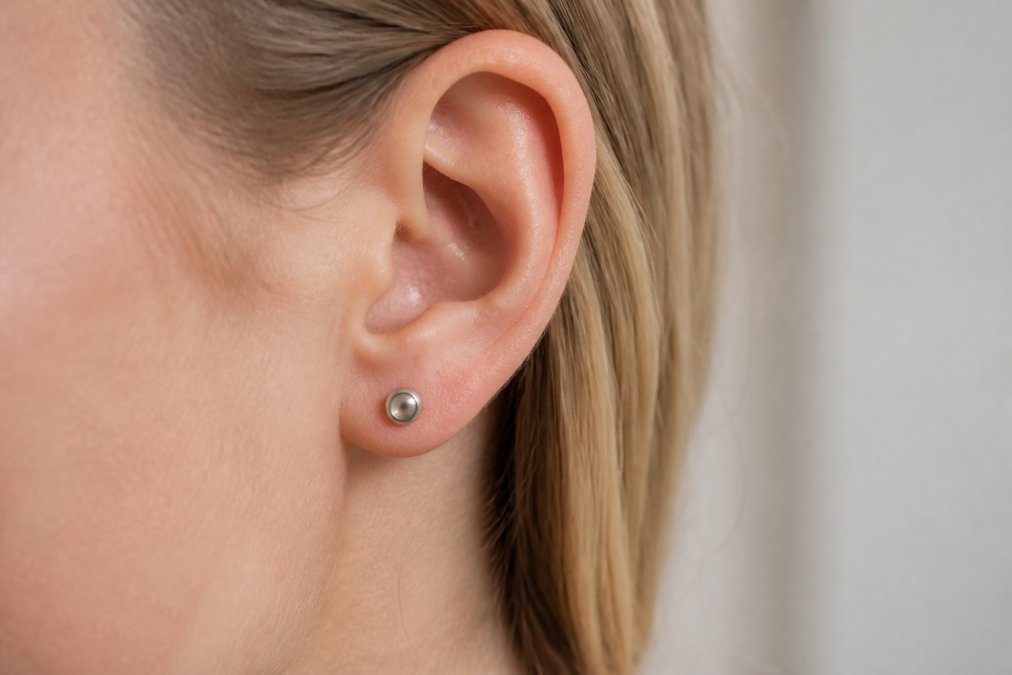
The best jewelry for sensitive ears is made from implant-grade titanium or solid gold of at least 14 karat, because both are biocompatible, corrosion-resistant, and free of the nickel that drives most reactions. Titanium wins for new and healing piercings; solid gold wins for healed piercings where you want a specific look. Sterling silver, platinum, and niobium are reasonable secondary options, but each has a caveat worth knowing before you buy.
Here is how the main options compare:
| Metal | Nickel Risk | Best For | Watch Out For |
|---|---|---|---|
| Implant-grade titanium | None | New piercings, daily wear | Higher cost than surgical steel |
| Solid gold (14K+) | Low | Healed piercings, style | 10K and below may contain nickel |
| Niobium | None | Color-anodized pieces | Limited styles, softer metal |
| Platinum | None | Long-term investment pieces | Expensive, heavy |
| Sterling silver | Low | Healed lobes only | Tarnishes, not for fresh piercings |
Implant-Grade Titanium: The Gold Standard for New Piercings
Implant-grade titanium is the material we reach for first, and it is not close. It is biocompatible enough to be used in surgical implants, it is essentially inert in skin contact, and it does not contain nickel at levels that provoke reactions in sensitized people. It is also lightweight, which matters more than most guides admit, because a heavy earring on a healing piercing creates the friction and micro-trauma that turns a mild irritation into a bump.
Solid Gold: Karat, Purity, and What to Look For
Solid gold is the better choice once a piercing has fully healed, because it holds a shape, takes a polish, and comes in the styles people actually want to wear. The key variable is karat. Higher karat means more gold and less alloy, and the alloy is where nickel hides. Fourteen karat is the practical floor for sensitive ears; 18 karat is better if your budget allows, and 24 karat is too soft for most earring posts.
When you are shopping for solid gold, look for the karat stamp on the post itself, not just the packaging. A piece marked “14K” on the card but unmarked on the metal is a coin flip. Reputable makers stamp the post because they expect you to check.
Metals to Avoid: Nickel, Cobalt, Brass, and Plated Jewelry
The metals to avoid if your ears react are nickel, cobalt, brass, and anything plated. These four can account for a majority of reactions, and they share a common trait: they are often cheap, easy to cast, and used almost universally in fashion jewelry because the cost difference can be enormous. Understanding why each one causes problems makes it easier to spot them on a label or in a display case.
Nickel: The Most Common Metal Allergen
Nickel is the single most frequent cause of allergic contact dermatitis from jewelry. It is also the cheapest and most widely used base metal in costume jewelry, which is not a coincidence. The reaction is a delayed hypersensitivity: the immune system identifies nickel ions released from the metal as a foreign body, and the response shows up hours to days after contact, not immediately.
Cobalt: The Frequent Co-Allergen
Cobalt is a common co-allergen with nickel, meaning a person reactive to one often reacts to the other. It appears in some alloys used for costume jewelry and in certain metal finishes. If you have a confirmed nickel allergy and a piece you thought was safe still causes a reaction, cobalt is one of the first things to suspect.
Brass: Tarnish, Trace Nickel, and Green Skin
Brass is a copper-zinc alloy. It tarnishes quickly, and the green discoloration it leaves on skin is a copper salt, not an allergic reaction in itself. The bigger problem is that brass often contains trace nickel from the manufacturing process, and it is frequently the base metal underneath gold plating. A brass core with a thin gold layer is a common construction in fashion earrings, and it is a common trigger.
Plated Jewelry: The Worst Offender
Plating is the worst offender because it fails exactly where skin contact is most constant. The post and the backing are the two points of continuous contact, and they are also the two points that take the most friction from insertion, removal, hair, and clothing. The plating wears through there first, exposing the base metal underneath precisely where it does the most damage.
If a piece has worn to a duller color at the post, stop wearing it. That discoloration is the plating failing, and the base metal underneath is now in direct contact with your skin. This is the single most common trigger we see in people who insist their earrings are “gold.”
The Surgical Steel Nuance
Surgical steel is often recommended as a safe option, and it is better than costume jewelry, but it is not nickel-free. Most surgical steel contains a small percentage of nickel bound in the alloy, and while many people tolerate it fine, a genuinely sensitized person can still react. If you have had a confirmed nickel reaction, do not treat surgical steel as a safe fallback.
How to Spot These Metals Before You Buy
- Look for the material name, not the adjective. “Hypoallergenic” and “sensitive-skin friendly” are marketing terms. “Implant-grade titanium” and “14K solid gold” are specific, checkable descriptions.
- Check the post, not the packaging. A piece stamped “14K” on the card but unmarked on the metal is a coin flip.
- Treat “gold-tone,” “gold-plated,” and “gold-filled” as base-metal pieces. They are not solid gold, and they will eventually expose the core.
- Be skeptical of low-priced “titanium.” Genuine implant-grade titanium is expensive, and shops advertising it cheaply are usually selling a lower grade with a different composition.
The pattern is consistent: the cheaper the metal, the more likely it contains one of these four offenders. That price gap is real, and it is the thing you are actually paying for when you choose implant-grade titanium or solid gold.
Hypoallergenic vs. Nickel-Free: What the Labels Actually Mean
Hypoallergenic is a marketing term with no legal definition in the United States. It means the manufacturer believes the product is less likely to cause a reaction, and nothing more. There is no standard, no test, and no enforcement behind it. A piece labeled hypoallergenic can still contain nickel.
ASTM F-136 Titanium vs G23: Why the Grade Matters
ASTM F-136 is the specification for titanium alloy used in surgical implants, and it is the standard that matters for piercing jewelry. G23, by contrast, is a common industry shorthand for a lower-grade titanium that is often marketed as equivalent. It is not equivalent. The two differ in alloy composition, trace element content, and how the metal behaves in prolonged skin contact.
The single most useful question you can ask any piercer is: “What grade is this jewelry, and can you show me the mill certificate or supplier spec?” A shop that uses implant-grade titanium will typically have an answer ready.
How to Test for Metal Allergies at Home
A home metal test cannot diagnose a nickel allergy, but it can narrow down which of your earrings is the problem, and it can do it without a dermatologist visit. There are two practical methods, and they answer different questions.
Method 1: The Skin Spot Test (Which Pair Is Guilty?)
This is the test to run first, because it uses the jewelry you already own and requires nothing you have to buy.
- Pick a control site. The inner forearm is the standard spot. It is thin-skinned, easy to see, and rarely exposed to the metals you are testing, so a reaction there is meaningful.
- Clean the area. Wash with mild soap and water, rinse, and pat dry. Do not apply lotion, sunscreen, or perfume, because any of those can produce a false positive.
- Tape the suspect piece against the skin. Use a hypoallergenic medical tape or a bandage. The metal needs direct, continuous contact with skin, not fabric.
- Leave it for 24 to 48 hours. Do not peek and re-tape. The reaction window for nickel contact dermatitis is typically 24 to 72 hours after exposure, so a mark that appears at hour six is more likely friction or irritation than allergy.
- Read the result. A red, raised, itchy patch confined to where the metal sat is a strong signal. No reaction after 48 hours does not fully clear the piece, because sensitization is cumulative and a single short exposure may not be enough to provoke a flare.
Method 2: Nickel Detection Kits (Does This Metal Contain Nickel?)
Nickel test kits use a chemical reagent, typically dimethylglyoxime, that turns pink or red in the presence of nickel ions. They are sold as swabs, dropper bottles, and pre-treated test papers.
How to use one:
- Clean the metal surface with alcohol and let it dry.
- Apply the reagent to the area that touches skin, not the decorative face. The post, the backing, and the clasp are where contact happens.
- Wait the interval the kit specifies, usually one to two minutes.
- Compare the color against the kit’s reference card.
What Home Testing Cannot Tell You
- It cannot distinguish a true allergy from a sensitivity. Both produce the same visible reaction; only patch testing by a dermatologist separates them.
- It cannot rule out cobalt, chromate, or other metal allergens. A piece that tests nickel-free can still provoke a reaction in someone sensitized to cobalt, which is a frequent co-allergen.
- It cannot predict how a piece will behave after six months of wear, sweat, and friction. Plating failure is a time-dependent problem, and no home test models it.
If you have had a severe reaction, meaning blistering, spreading rash, or swelling beyond the contact site, skip the home tests and see a dermatologist. Patch testing is the only way to get a definitive answer, and it identifies the specific metals you need to avoid rather than just the specific earrings.
Keep a small notebook or a phone note with the results. Record the piece, the date, the test method, and the outcome. After a few months you will have a personal safe-list and a personal avoid-list, which is more useful than any generic buying guide.
Preventing Piercing Irritation Bumps: Weight, Fit, and Aftercare
Preventing piercing irritation bumps comes down to three variables: weight, fit, and aftercare. Bumps form when a healing piercing is subjected to repeated mechanical stress, and the most common source of that stress is jewelry that is too heavy, too long, or too loose. A heavy earring pulls on the fistula, a too-long post catches on hair and clothing, and a loose backing lets the jewelry rotate and drag.
The fix is unglamorous but effective:
- Downsize on schedule. Initial jewelry is intentionally longer to accommodate swelling. Once swelling subsides, usually within a few weeks, switch to a fitted post. Wearing the long post indefinitely can be a common cause of bumps.
- Keep it light. For a healing piercing, a small stud beats a dangling piece every time. Save the statement earrings for healed piercings.
- Do not sleep on it. Pressure against a pillow for eight hours a night is more mechanical stress than most people realize. A travel pillow with your ear in the hole solves this.
- Clean with saline, not alcohol or peroxide. Alcohol dries the tissue and slows healing. Sterile saline spray is the standard recommendation.
- Leave it alone. Rotating, picking, and “checking” a healing piercing reintroduces bacteria and disrupts the forming tissue.
Post-Reaction Recovery: What to Do When Your Ear Reacts
When your ear reacts, the protocol is remove, clean, calm, and wait. Take the jewelry out as soon as you notice itching or redness, clean the area gently with sterile saline, and leave it bare until the skin returns to normal. Do not reinsert the same piece. Do not apply antibiotic ointment unless a doctor tells you to, because ointments trap moisture and can make contact dermatitis worse.
Sustainability and Ethical Sourcing in Hypoallergenic Jewelry
Sustainability and safe materials overlap more than most buyers expect. Titanium and gold are both highly recyclable, and because they are valued for their material properties rather than their finish, they tend to stay in circulation rather than ending up in a landfill after the plating fails. Costume jewelry has the opposite profile: it is cheap to produce, hard to repair, and designed to be replaced.
Caring for Sensitive Ear Jewelry: Cleaning and Maintenance
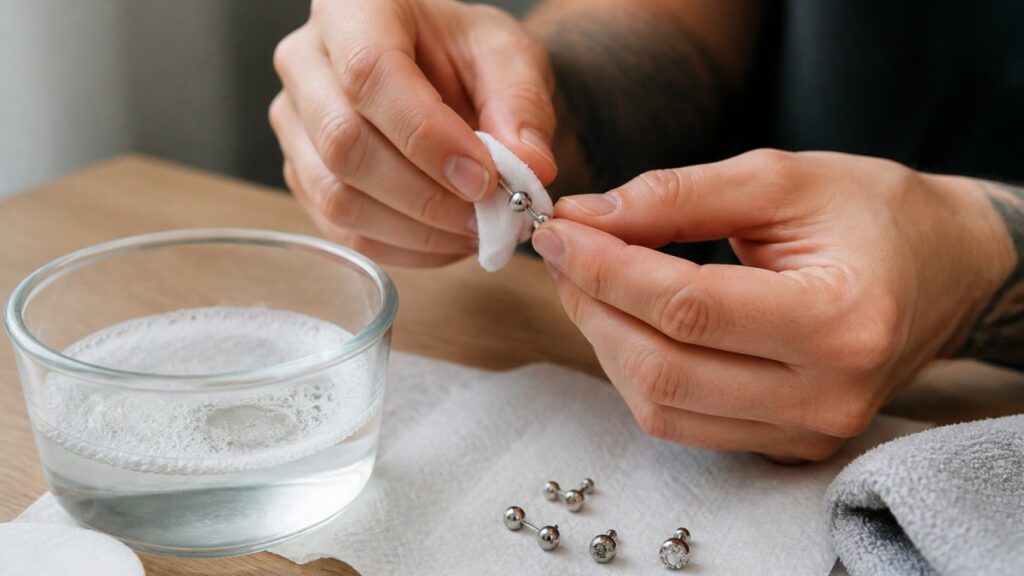
Cleaning sensitive ear jewelry is mostly about removing the buildup that causes irritation, not about sterilizing. Skin oils, soap residue, and dead skin cells collect on the post and backing, and that film holds bacteria against the piercing. A weekly clean prevents most of the low-grade irritation people attribute to their metal.
For implant-grade titanium and solid gold:
- Soak the piece in warm water with a drop of mild dish soap for a few minutes
- Use a soft toothbrush to clear the post, the threading, and the backing
- Rinse thoroughly and pat dry with a clean cloth
- Wipe the post with isopropyl alcohol and let it air dry before reinserting
Choosing the Best Jewelry for Sensitive Ears: A Decision Framework
Choosing the best jewelry for sensitive ears comes down to two questions: is the piercing healed, and what is the metal specification? Work through the framework below and you will land on the right material without guessing. Establishing these foundational standards for established piercings remains equally vital when choosing first piercing jewelry for a fresh site.
| Your Situation | Recommended Material | Why |
|---|---|---|
| New piercing, still healing | Implant-grade titanium | Inert, lightweight, no nickel |
| Healed lobe, confirmed nickel allergy | 14K+ solid gold or titanium | No base metal exposure |
| Healed lobe, no known allergy | 14K solid gold, niobium, platinum | Style range with low risk |
| Tight budget, healing piercing | Implant-grade titanium stud | Cheapest safe option is still titanium |
| Statement or dangle piece | Solid gold on healed piercing only | Weight is safe once healed |
Frequently Asked Questions
What kind of jewelry doesn’t hurt my ears?
Jewelry made from implant-grade titanium (ASTM F-136), solid 14K or higher gold, niobium, or platinum is least likely to cause irritation. These metals are biocompatible and nickel-free, so they don’t trigger the allergic reactions that cheap earrings often do. Avoid anything labeled gold-plated, gold-filled, or surgical steel, since those can contain nickel or cobalt that leaches onto your skin over time.
Is titanium or sterling silver better for sensitive ears?
Implant-grade titanium is the better choice for sensitive ears. Sterling silver contains copper and sometimes nickel, which can cause contact dermatitis and tarnish. Titanium is non-reactive, corrosion-resistant, and lightweight, making it ideal for daily wear and new piercings. If you love the look of silver, choose titanium with a polished finish instead.
Can cheap jewelry cause keloid bumps?
Cheap jewelry often contains nickel or cobalt that triggers allergic reactions, leading to redness, swelling, and irritation bumps. These bumps are usually irritation granulomas, not true keloids, but they can become permanent if you keep wearing the offending metal. Switching to implant-grade titanium or solid gold and following proper piercing care usually resolves them.
How do I know if my jewelry is causing an allergic reaction?
Signs of jewelry allergy include itching, redness, swelling, and a crusty or weeping rash around the piercing. Symptoms often appear hours to days after putting on the earring and improve when you remove it. If the reaction spreads or you develop pustules, see a dermatologist. A patch test can confirm which metal is responsible.
Why is high-grade titanium recommended for new piercings?
High-grade titanium like ASTM F-136 is biocompatible, meaning your body accepts it without an immune response. It’s nickel-free, corrosion-resistant, and lightweight, so it doesn’t weigh down a healing piercing. This reduces the risk of irritation bumps and lets your body heal properly. G23 titanium may contain trace nickel, so it’s not the best choice for sensitive skin.