Last Updated: November 8, 2026
Quick Summary
Finding an affordable piercing means budgeting for the full visit, not just the piercing fee: jewelry, aftercare supplies, and any follow-up visit all add to the total. Ask the studio to quote your complete out-of-pocket cost in writing, and confirm whether any student discount applies to the fee, the jewelry, or both. Choosing implant grade titanium and buying sterile saline at a pharmacy keeps an affordable piercing safe without cutting corners on healing.
- Ask for the full total before you book, since the advertised fee often covers only the piercing itself.
- Get any student discount confirmed in writing, including whether it applies to jewelry or just the fee.
- Set a ceiling for the whole visit and tell your piercer up front so nothing surprises you at the counter.
- Buy your own sterile saline at a pharmacy and save the jewelry upgrade for a later visit.
- Skip alcohol, hydrogen peroxide, and ointments, which slow healing and waste money.
Table of Contents
- Why Affordable Piercing Requires a Smarter Budget
- Piercing Studio Safety Checks That Protect Your Wallet
- Piercing Healing Time and What It Costs You
- Piercing Aftercare on a Student Budget
- Ear Piercing Ideas for College Students
- Jewelry Upgrades and Long-Term Value
- Book a Piercing Consultation at Sideshow Tattoo and Piercing
- Frequently Asked Questions
Why Affordable Piercing Requires a Smarter Budget
Affordable piercing options for college students start with one honest idea: the fee you pay at the counter is not the full cost. A cheap piercing that needs redone, or jewelry that irritates your ear, costs far more in the end.
A piercing is a small wound that needs quality metal and proper care to heal well. The price tag is only one part of the picture.
The Total Cost Beyond the Piercing Fee
Some studios quote a piercing fee and charge separately for jewelry, while others bundle it in. Ask for the full total before you sit down, and confirm what is and is not included.
Here is how the pieces commonly add up, in the order they hit your wallet:
- Piercing fee, the service charge for the placement itself.
- Jewelry, varies by metal and style. Implant grade titanium is a common choice for new piercings; solid gold and gem-set ends cost more.
- Aftercare supplies, sterile saline and clean gauze, which you can often buy at a pharmacy.
- Follow-up visit or jewelry change, some studios may charge for a downsize or a jewelry swap after the initial swelling goes down.
- Your time, a placement that heals slowly can mean more cleaning, more check-ins, and possibly a redo.
A common pattern is that the advertised fee covers only the first item on that list. Before you book, ask the studio to quote the full out-of-pocket total for your specific placement and jewelry choice, including any walk-in charge and aftercare. You can see how these pieces add up by checking our piercing prices before you book.
How to Verify Student Discounts and Promotions
A student discount is only useful if it is real. Ask these questions before you count on one:
- What proof do you need, and does a digital student ID count?
- Does the discount apply to jewelry, or just the piercing fee?
- Is it a standing offer or a limited promotion?
Get the answer in writing, by message or email. Watch out: a “deal” that bundles cheap jewelry can cost more once the metal irritates your ear and you pay again to replace it.
A simple script works better than a vague question. Try: “I’m a student with a valid ID. Can you confirm in writing whether the discount applies to the piercing fee, the jewelry, or both, and whether it stacks with any current promotion?” That one message tells you whether the offer is real and how much it actually saves.
Budget Planning and Payment Questions
Plan the total before you commit, not after. A realistic approach for a student budget:
- Decide your ceiling for the full visit, fee, jewelry, aftercare, and tax, and tell the piercer up front.
- Ask about any deposit required to hold an appointment and about the payment methods the studio accepts, so you are not caught short at the counter.
- Build in a small buffer for a follow-up visit or a jewelry downsize.
- If the total is out of reach this month, consider booking a later date rather than choosing cheaper jewelry that may irritate your ear.
Saving strategies that can help: buy your own sterile saline at a pharmacy, and put the jewelry upgrade on your list for a later visit once the piercing has healed. The goal is to spread the cost without cutting the parts that protect your health.
Piercing Studio Safety Checks That Protect Your Wallet
Piercing studio safety matters. Checking a few basics before you book can help you avoid a repeat visit or an infection. You can check much of it in a few minutes.
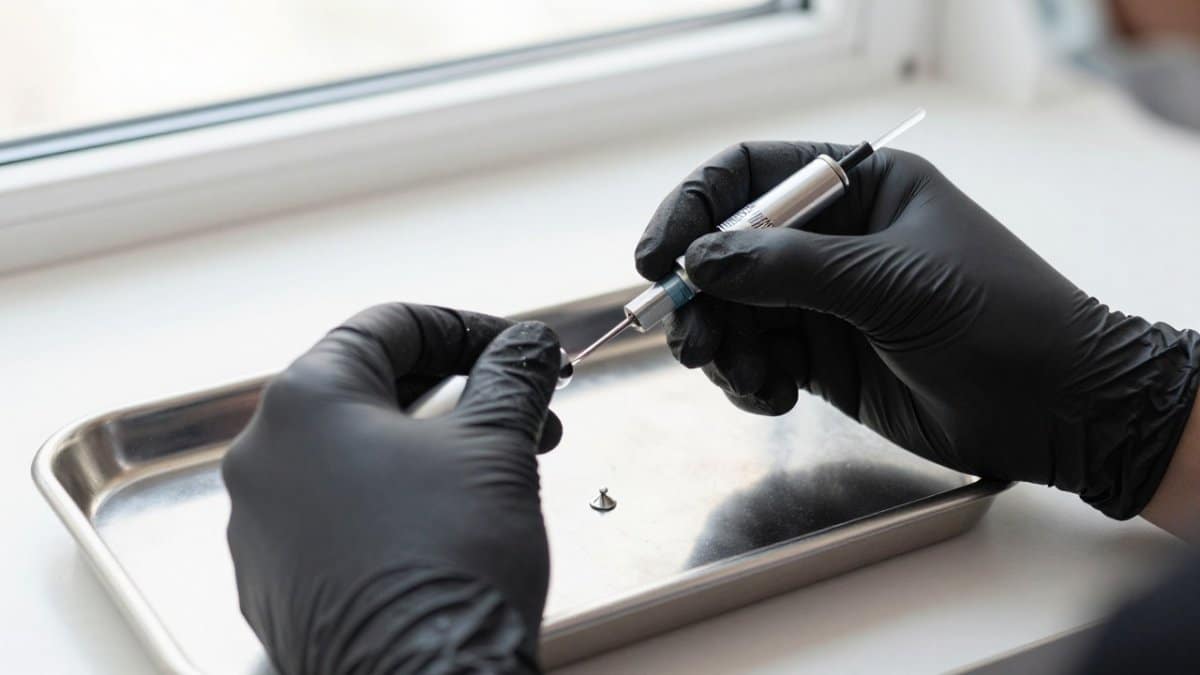
Ask whether the studio uses a sealed, single-use needle opened in front of you, and ask how its autoclave, the machine that sterilizes tools, is tested. Ask what metal the jewelry is. Implant grade titanium is a common choice for fresh piercings.
You can learn how to confirm credentials step by step in our guide to verifying a certified piercer.
Needle vs. Gun: What the Equipment Tells You
A piercing needle is hollow and sharp, and it removes a tiny piece of tissue so jewelry slides in cleanly. A piercing gun forces a blunt stud through the ear. Guns are harder to sterilize fully and cause more trauma to cartilage.
Here is the short version:
| Equipment | Best for | Main concern |
|---|---|---|
| Single-use needle | Lobe and cartilage | Needs a skilled hand |
| Piercing gun | Lobe, sometimes | Harder to sterilize, more trauma |
If a studio reaches for a gun on your cartilage, walk away.
Piercing Healing Time and What It Costs You
Healing time is a cost, because a piercing that is still healing limits what you can do. Lobe piercings often settle in a few weeks. Cartilage piercings, like a helix or conch, can take many months to fully heal. Some piercers tell clients to plan on up to eight months for cartilage.
That matters on a student schedule. A healing piercing means no swimming in shared water, no sleeping on that side, and no skipping cleaning. If you rush it, you risk irritation bumps and a longer, more expensive road.
Ask your piercer for a realistic timeline for your specific ear placement. Then plan around it.
Piercing Aftercare on a Student Budget
Piercing aftercare does not require an expensive kit. It requires consistency. Keep the area clean, keep your hands off it, and leave the jewelry in until it is fully healed.
Aftercare supplies are usually a small part of the cost. A piercing that gets irritated can mean a longer healing window, a follow-up visit, and sometimes a redo.
What to Buy and What to Skip
You can build a complete aftercare kit for very little if you buy the right things and skip the rest.
Buy:
- Sterile saline wound wash, available at most pharmacies. Check the label for sodium chloride and water only.
- Clean gauze or paper towels for patting dry. Do not use a shared cloth towel.
- A travel-size bottle for your bag so you can clean on campus between classes.
Skip these money-wasters:
- Harsh alcohol or hydrogen peroxide, which slow healing
- Rotating the jewelry, which tears new tissue
- Cheap “healing” ointments that trap bacteria
- Elaborate multi-step kits with products you will not use
Follow our suggested aftercare steps so you heal right the first time.
How Healing Time Affects the Real Value
Healing time is a cost, because a piercing that is still healing limits what you can do. Lobe piercings often settle in a few weeks. Because cartilage can take months to heal, choosing simple jewelry you can comfortably wear throughout that time matters as much as the piercing itself, and SMOOTHLIVING.shop offers another perspective on making everyday pieces last.
That matters on a student schedule. A healing piercing means no swimming in shared water, no sleeping on that side, and no skipping cleaning. If you rush it, you risk irritation bumps and a longer, more expensive road.
Ask your piercer for a realistic timeline for your specific ear placement. Then plan around it. If you have a busy semester ahead, a faster-healing lobe may give you more value than a cheaper cartilage placement that needs months of careful care.
When to Call the Studio
Most irritation is fixable if you catch it early. Contact your piercer if you see spreading redness, swelling that gets worse after the first week, pus that is not clear, or a bump that does not settle with consistent cleaning. A quick check-in is usually free or low-cost, and it is far cheaper than waiting until the piercing has to come out.
Ear Piercing Ideas for College Students
Ear piercing ideas for college students should match your schedule, not just your Pinterest board. Some placements heal faster and catch on less.
Popular choices include the lobe, helix, conch, and tragus. Each has a different healing timeline and a different level of care.
Low-Maintenance Placements for Busy Schedules
Lobe piercings are often considered the simplest to care for. A single helix is a common next step for those who want something visible but simple. Tragus and conch piercings sit deeper in cartilage and typically need more patience.
Start with one or two. Add more once you know how your body heals. You can browse placements and book with our professional piercer when you are ready.
Jewelry Upgrades and Long-Term Value
Inexpensive jewelry of unknown metal can cause irritation and may need to be replaced. Implant grade titanium and solid gold cost more up front, and are often chosen for their durability.
A jewelry upgrade is a one-time cost that protects your piercing fee. Ask what metal you are getting and why. If the answer is vague, ask again. To judge long-term value, read what implant grade titanium jewelry costs and compare it to the price of redoing a failed piercing.
Book a Piercing Consultation at Sideshow Tattoo and Piercing
A smart budget starts with a real conversation, not a coupon. Bring your questions, your student ID, and your plans for the next few months. We will walk you through placement, jewelry, and aftercare so you know the full cost before anything happens.
At Sideshow Tattoo and Piercing, our hand-picked professional artists use only quality jewelry for piercing services. We focus on a safe, comfortable experience. Contact us to talk through your placement and options.
Contact Sideshow Tattoo and Piercing to get started.
A cheap piercing is only cheap if it heals. Choose quality jewelry, a clean studio, and honest aftercare, and your budget goes further than any discount ever will.
Frequently Asked Questions
How can college students find affordable piercing options without sacrificing safety?
Start by calling studios and asking what the piercing fee includes, whether jewelry is separate, and if student discounts apply. A low headline price often excludes jewelry or aftercare supplies. Ask whether the studio uses single-use needles, an autoclave for sterilization, and implant-grade jewelry. A slightly higher upfront fee at a studio that meets these standards usually costs less over time than replacing a rejected piercing or treating an infection.
Does the price of a piercing include the jewelry?
It depends on the studio. Some quote a single fee that covers the piercing service and basic jewelry, while others charge separately for the procedure and the piece. Always ask for the total before you sit down. If jewelry is separate, confirm the material and threading style so you know what you are paying for. Implant-grade titanium is a common starting point for a new piercing, and decorative ends can add to the total.
How much should I budget for piercing aftercare?
Aftercare is usually the smallest line item, but it is not zero. Sterile saline wound wash is a common aftercare product. Budget also for keeping the area clean while it heals, and ask your studio which products they recommend and whether a follow-up check is included in the piercing fee.
Which piercings are easiest to care for while in college?
Lobe piercings and single cartilage placements like the tragus or helix are common starting points because they are easy to keep clean and less likely to catch on hair, helmets, or clothing. Avoid placements that sit under glasses frames, headphone cushions, or sleep-side pressure if you toss and turn. If you play contact sports or swim regularly, ask your piercer which placements fit your routine before you commit, since irritation slows healing time.